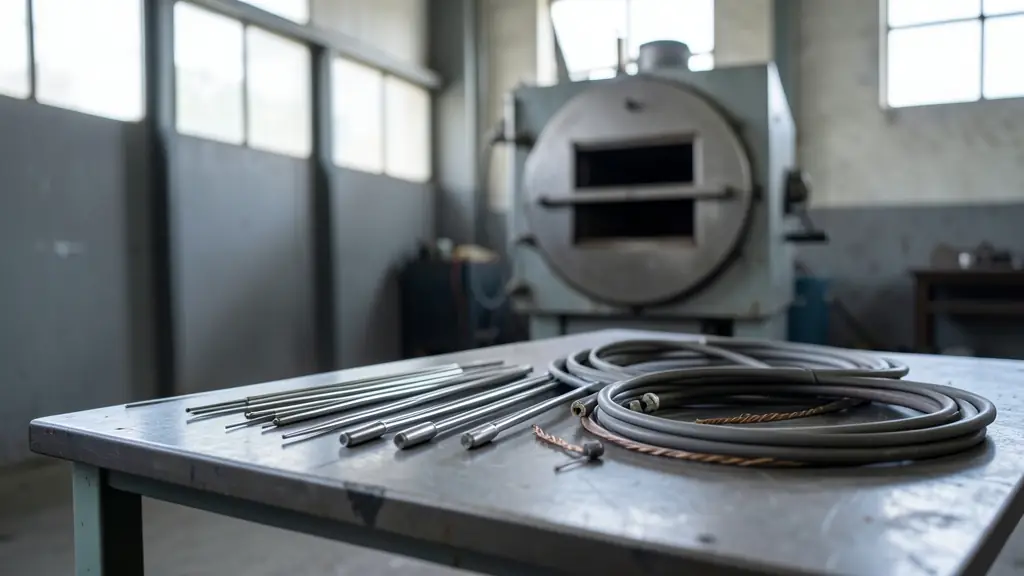
A thermocouple is two wires of different metals joined at the tip. Heat the tip and a small voltage appears that changes with temperature, which an instrument turns into a reading. They are cheap, tough, fast and cover a huge range, from freezers to furnaces, so they are the most common temperature sensor in industry. This page covers the types, probe styles, cable and plugs, and the separate flame failure thermocouple in gas appliances. Send one request and suppliers who make or stock thermocouples quote you directly.
Types of thermocouple
Each type is a different pair of metals with its own range and letter.
- Type K: the most common, general purpose to about 1,200 °C. Most handheld meters and many temperature guns take a Type K plug.
- Type J: older plant and plastics machinery, a lower top range than K.
- Type T: good at low temperatures, used in food and cold work.
- Type N: more stable than K at high heat over long periods.
- Types R, S and B: platinum types for very high heat in glass, steel and ceramics, and costly.
For the highest temperatures without contact, see pyrometers.
Probe styles, cable and plugs
Mineral insulated (MI) sheathed probes bend and survive vibration and heat. There are also bare wire tips for fast response, bayonet probes for plastics machines, surface probes for pipes and plates, and needle probes for food. Between the probe and the instrument you need the right extension or compensating cable, not ordinary copper, or the reading drifts. Plugs and sockets come in miniature and standard sizes, colour coded by type under IEC 60584. Give the supplier the type, sheath material and diameter, length and the connection you need.
Accuracy and when a PT100 is better
Thermocouples are less accurate and drift more over time than platinum resistance sensors, especially when run hot for long periods. Tolerances depend on the type and class: check the data sheet. Where you need tight accuracy below about 600 °C, a PT100 probe is often the better choice. For process control and audits, have thermocouples and their instruments checked by an accredited calibration lab.
Gas appliance thermocouples
The thermocouple in a gas geyser, stove, heater or braai is a flame failure device: the pilot flame heats it and it holds the gas valve open, closing it if the flame goes out. It is a different part from a measuring thermocouple. Universal kits exist, but the nut, the tip and the length vary between makers, so take the old one or the appliance model with you. Buy the length and fitting that match your appliance, and where the appliance is a fixed installation, have it replaced by a registered gas installer.
What to put in your request
- The type: K, J, T, N, R, S or B
- The probe style, sheath material and diameter
- The length and the process connection
- The plug, cable length and cable type
- How many, and whether certificates are needed
Thermocouples for industry, food, health, labs and homes
- Factories, mines and plants: thermocouples in furnaces, kilns, heat treatment, plastics machines and boilers
- Kitchens, butcheries and food factories: needle and oven thermocouples on cooking lines and in bakery ovens
- Hospitals, clinics and pharmacies: thermocouples in sterilisers and autoclaves checked during maintenance
- Electricians, HVAC and refrigeration technicians: Type K probes for HVAC technicians and replacement gas appliance thermocouples
- Labs, schools and universities: fine wire and sheathed thermocouples for experiments, ovens and furnaces
- Cold stores and distributors: Type T probes for freezer and reefer trials
- Farms, poultry houses and packhouses: thermocouples in grain driers, incubators and tobacco barns
- Households and families: a replacement thermocouple for a gas heater, braai or stove
- Property managers, inspectors and security: thermocouples for gas geysers and boilers in estates and buildings
Frequently asked questions
Do you sell thermocouples yourselves?
How do I know which type of thermocouple I have?
Can thermocouples be made to my length?
My gas heater will not stay lit. Is it the thermocouple?
Thermocouples by province and city
- Johannesburg
- Pretoria
- Centurion
- Midrand
- Sandton
- Randburg
- Roodepoort
- Krugersdorp
- Randfontein
- Germiston
- Boksburg
- Benoni
- Kempton Park
- Alberton
- Vanderbijlpark
- Vereeniging
- Durban
- Pinetown
- Pietermaritzburg
- Richards Bay
- Newcastle
- Ladysmith
- Gqeberha (Port Elizabeth)
- East London
- Kariega (Uitenhage)
- Mthatha
- Cape Town
- Bellville
- Paarl
- Stellenbosch
- George
- Worcester
- eMalahleni (Witbank)
- Middelburg
- Secunda
- Mbombela (Nelspruit)
- Rustenburg
- Brits
- Klerksdorp
- Potchefstroom
- Mahikeng
- Polokwane
- Tzaneen
- Kimberley
- Upington
- Bloemfontein
- Welkom
- Sasolburg