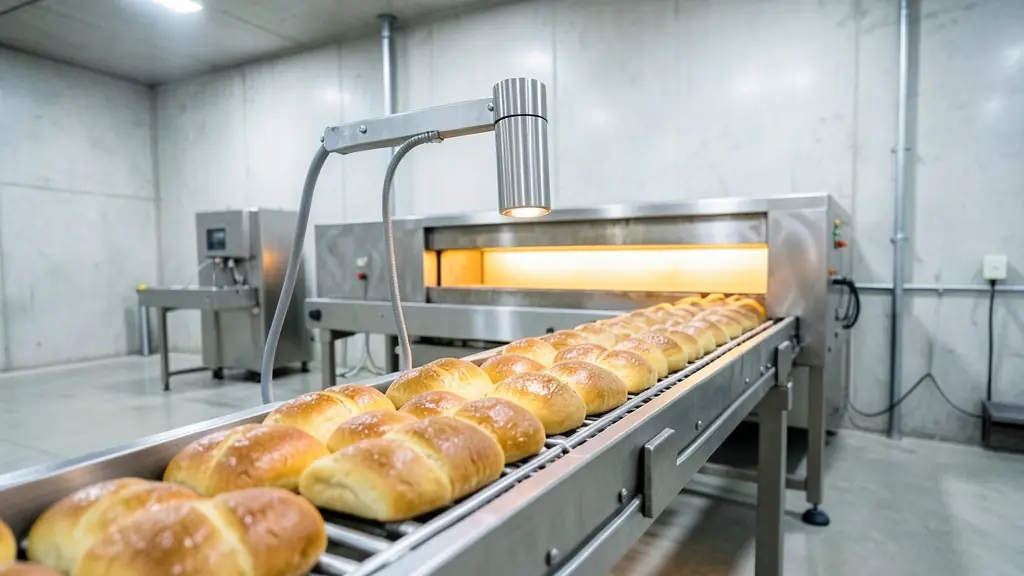
A fixed infrared temperature sensor is mounted on a bracket, aimed at a process and wired to a PLC or controller, so the temperature of a moving line is measured all the time without touching it. Steel and aluminium mills, glass plants, plastics extruders, paper machines, asphalt plants, food ovens and packaging lines use them to control heat, reject bad product and keep records. Choosing one is about the material, the spot at your distance, the speed and the environment. This page explains what to specify. Send one request and instrument suppliers near you quote you directly.
How they connect to your process
Most fixed sensors give a 4 to 20 mA signal scaled to a temperature range, which almost every PLC, controller and recorder accepts. Many also offer digital outputs and fieldbus connections, alarm relays and a local setup tool. Some have a small head with the electronics in a separate box, which helps where the spot is hot. Set the range to the band you actually care about, as a narrower range gives finer control. Plan where the signal goes: straight into a control loop, to an alarm that stops the line, or to a recorder that keeps the batch record your customers or auditors ask to see.
Choosing the right sensor
- Temperature range: low-temperature models for food, paper and packaging; high-temperature ones for steel and glass; see pyrometers for furnace work.
- Wavelength: special wavelengths for glass, thin plastic film and metals, which general sensors read badly or straight through.
- Spot size at your working distance, which must sit inside the product even as it wanders across the belt.
- Response time for fast lines and short products.
- Emissivity: set for the product, and for shiny metal consider a two-colour model.
Mounting and protecting it
Mount the sensor on a rigid bracket with a clear view, square to the product where possible, and away from steam and fumes that rise into the line of sight. In hot spots fit a water or air cooling jacket; in dusty or oily air an air purge collar keeps the lens clean; and where splashes or wash-downs happen, a protective window and a suitable IP rating. Use screened cable and keep it away from drives and heater cables. A sighting laser or a sighting tube helps aim the head during setup.
Line scanners and cameras for whole widths
A single sensor reads one spot. When you need the whole width of a strip, web, sheet or kiln shell, a line scanner sweeps across the product and builds a heat map, and a fixed radiometric thermal camera watches an area. Both cost more but find edge-to-edge problems. For contact measurement inside pipes and tanks, look at PT100 probes and thermocouples. Plan for checks against a blackbody; see calibration.
What to put in your request
- The product and process the sensor will watch
- The temperature band and line speed
- Distance from the sensor to the product and its width
- Heat, dust, steam or wash-downs at the mounting spot
- The signal your PLC or controller needs
Fixed Infrared Temperature Sensors for industry, food, health, labs and homes
- Factories, mines and plants: steel strip, glass, extruded plastic, paper webs and asphalt measured on the move
- Kitchens, butcheries and food factories: products leaving ovens, fryers and chillers measured continuously for control and records
- Hospitals, clinics and pharmacies: rarely needed: medical sites use probes, loggers and clinical thermometers instead
- Electricians, HVAC and refrigeration technicians: integrators and instrument technicians fitting and commissioning sensors on lines
- Labs, schools and universities: pilot plants, test rigs and research furnaces measured without contact
- Cold stores and distributors: product leaving blast chillers and spiral freezers checked on the line
- Farms, poultry houses and packhouses: grain dryers, feed pellet lines and packhouse treatments monitored on larger farms
- Households and families: rarely needed: a temperature gun covers home and hobby checks
- Property managers, inspectors and security: rarely needed: building plant uses probes and loggers for monitoring
Frequently asked questions
Do you supply or install sensors yourselves?
No. We pass your request to independent instrument suppliers and integrators who work in your area, and they quote you directly on the sensor, accessories and commissioning. We give no process or electrical advice. See how it works.
Can an infrared sensor read through a window?
Only through a window made for the sensor's wavelength. Ordinary glass and most plastics block the infrared that general sensors use. Ask the supplier for the right window material and allow for its effect on the reading. Keep the window clean, as a film of dust or oil on it lowers the reading too.
Why does my sensor read low on aluminium?
Bright aluminium has a very low emissivity, so it gives off little infrared and reflects its surroundings. Use a short-wavelength or two-colour sensor made for metals, measure an oxidised or coated part of the product, or use contact measurement.
How often should a fixed sensor be checked?
Your quality system sets that. Clean the lens and window regularly, compare against a handheld reference now and then, and send the head for a blackbody calibration at the interval your auditors expect, often yearly.
Fixed Infrared Temperature Sensors by province and city
- Johannesburg
- Pretoria
- Centurion
- Midrand
- Sandton
- Randburg
- Roodepoort
- Krugersdorp
- Randfontein
- Germiston
- Boksburg
- Benoni
- Kempton Park
- Alberton
- Vanderbijlpark
- Vereeniging
- Durban
- Pinetown
- Pietermaritzburg
- Richards Bay
- Newcastle
- Ladysmith
- Gqeberha (Port Elizabeth)
- East London
- Kariega (Uitenhage)
- Mthatha
- Cape Town
- Bellville
- Paarl
- Stellenbosch
- George
- Worcester
- eMalahleni (Witbank)
- Middelburg
- Secunda
- Mbombela (Nelspruit)
- Rustenburg
- Brits
- Klerksdorp
- Potchefstroom
- Mahikeng
- Polokwane
- Tzaneen
- Kimberley
- Upington
- Bloemfontein
- Welkom
- Sasolburg