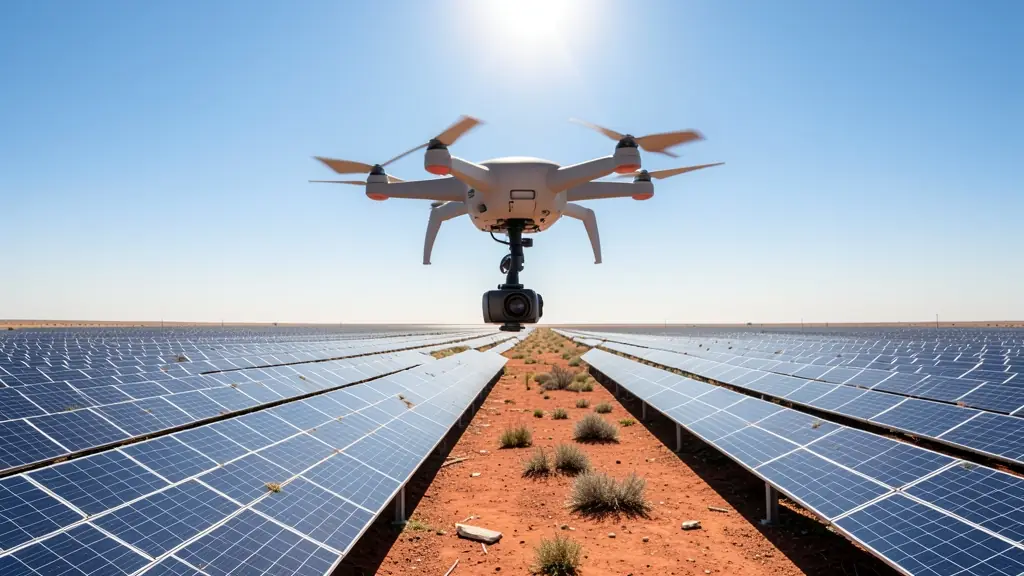
A drone thermal camera puts a heat picture where you cannot easily walk or climb: across a solar farm, over a factory roof, along power lines or across a game farm at dawn. You can buy a drone with a thermal payload and fly it yourself, or hire a drone inspection company that flies, analyses and reports. Either way, the camera specification and South African aviation rules matter. This page explains both routes and what to ask. Send one request and suppliers and licensed operators near you quote you directly.
Where drone thermal imaging is used
- Solar PV plants: hot cells, failed bypass diodes, dead strings and soiling across rows that would take days to walk.
- Roofs: wet insulation, leaks and failed seams on large flat roofs.
- Power lines and substations: hot joints and clamps along a route.
- Search and rescue: people in the veld or water at night.
- Game counts and anti-poaching: animals and intruders in the bush.
- Farming: irrigation faults and crop stress.
- Fires: hot spots in stockpiles and after veld fires.
The camera on the drone
Drone thermal payloads are often 640 x 512, with some lower, and are usually paired with a normal visual camera so each heat picture has a matching photo. For inspections, choose a radiometric payload so every pixel holds a temperature that the software can measure and report. The lens and the flying height decide how many pixels land on each solar cell or roof joint: fly higher and you cover more ground but see less detail. A stable gimbal, a zoom on the visual camera and mapping software that stitches many frames into one plan help on large sites. The basics of resolution and sensitivity are on our thermal imaging cameras page.
SACAA rules
Flying a drone commercially in South Africa needs approval from SACAA, the South African Civil Aviation Authority. Under Part 101 of the Civil Aviation Regulations, a company needs an RPAS operator certificate (ROC) and licensed remote pilots, and some airspace and sites need further permission. If you hire an inspection company, ask to see its ROC and the pilot's licence before the job. If you buy a drone for your own business use, plan for the same approvals: ask the supplier and a qualified aviation consultant what applies.
Buy a payload or hire an inspection
Buying suits large solar portfolios, security companies, mines and farms that fly often and have licensed pilots. Hiring an inspection suits one site, a commissioning check, an insurance claim or an annual report. A good report shows each fault with its thermal and visual picture, its position on a site plan and a priority. Solar inspections are usually flown in steady, strong sun; ask the operator what conditions they need. For boards on the ground, an electrical thermography survey fits better.
What to put in your request
- Buy a drone or payload, or hire an inspection
- What is inspected: solar plant, roof, lines or farm
- The size of the site, such as MW or hectares
- Where the site is and access arrangements
- The report you need and who it is for
Thermal Drone Cameras and Drone Inspections for industry, food, health, labs and homes
- Factories, mines and plants: plant roofs, stacks, conveyors and stockpiles surveyed from the air on large sites
- Kitchens, butcheries and food factories: large food factory and cold store roofs checked for leaks and wet insulation
- Hospitals, clinics and pharmacies: hospital roofs and plant on large campuses checked without scaffolding
- Electricians, HVAC and refrigeration technicians: solar installers checking new arrays at handover and roofers finding leaks
- Labs, schools and universities: university research on crops, wildlife and heat islands flown under SACAA approval
- Cold stores and distributors: large distribution centre roofs checked for leaks over stored stock
- Farms, poultry houses and packhouses: game counts, anti-poaching patrols, irrigation faults and crop stress seen from the air
- Households and families: rarely needed: a roof leak at home suits a ground-based thermal inspection
- Property managers, inspectors and security: large roofs, estates and solar on commercial buildings surveyed for owners and insurers
Frequently asked questions
Do you fly drones or sell them?
No. We pass your request to independent drone suppliers and licensed inspection operators who work in your area, and they quote you directly. We do not fly, inspect or certify anything. See how it works.
Can I fly a thermal drone on my own farm?
Private flying over your own land has its own rules, and as soon as the flying is for a business purpose SACAA approval usually applies. The rules change and depend on the situation, so check with SACAA or a qualified aviation consultant before you fly.
What does a solar plant drone inspection find?
Typically hot cells and cracked cells, failed bypass diodes, disconnected or dead strings, shading and soiling patterns, and hot junction boxes. The operator's report says where each fault is so your maintenance team can find the panel on the ground.
Will a thermal drone see people at night?
Yes, a warm body usually stands out clearly against cool ground at night, which is why rescue teams and game reserves use them. Detection gets harder in thick bush, in rain and when the ground is as warm as the body, such as on a hot summer evening.
Thermal Drone Cameras and Drone Inspections by province and city
- Johannesburg
- Pretoria
- Centurion
- Midrand
- Sandton
- Randburg
- Roodepoort
- Krugersdorp
- Randfontein
- Germiston
- Boksburg
- Benoni
- Kempton Park
- Alberton
- Vanderbijlpark
- Vereeniging
- Durban
- Pinetown
- Pietermaritzburg
- Richards Bay
- Newcastle
- Ladysmith
- Gqeberha (Port Elizabeth)
- East London
- Kariega (Uitenhage)
- Mthatha
- Cape Town
- Bellville
- Paarl
- Stellenbosch
- George
- Worcester
- eMalahleni (Witbank)
- Middelburg
- Secunda
- Mbombela (Nelspruit)
- Rustenburg
- Brits
- Klerksdorp
- Potchefstroom
- Mahikeng
- Polokwane
- Tzaneen
- Kimberley
- Upington
- Bloemfontein
- Welkom
- Sasolburg