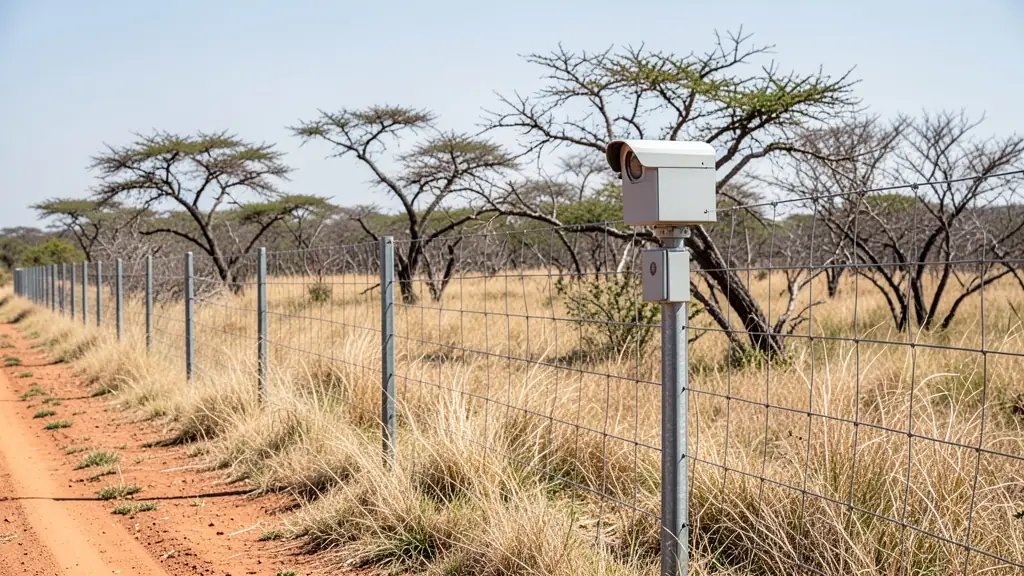
A thermal security camera sees the heat of people and vehicles, so it works in total darkness, without floodlights, and through light smoke and haze where a normal camera sees nothing. That makes thermal camera security a strong choice for long farm, estate, mine and solar plant perimeters, game reserves and yards, and for spotting fires early in stockpiles and warehouses. This page explains detection range, lenses, analytics and installation, and what to ask. Send one request and security suppliers and installers near you quote you directly.
Where thermal security fits
- Perimeters: farm boundaries, estates, mines, substations and solar plants where lighting a long fence is not practical.
- Game reserves: intruders and vehicles in the bush at night.
- Yards and depots: trucks, stock and copper cable left out overnight.
- Early fire detection: radiometric cameras that alarm when a coal, wood chip, tyre, recycling or waste stockpile, or a warehouse, starts heating up.
Thermal cameras do not show faces or number plates, so most sites pair them with normal cameras that can identify what the thermal camera detects.
Range, lens and resolution
Range depends on the lens, the sensor resolution and the weather. Makers quote three distances: detection (something warm is there), recognition (a person, an animal or a vehicle) and identification. Detection is much further than recognition, so check which figure you are being sold. A narrow lens sees further down a straight fence but covers a thin strip; a wide lens covers a yard but not as far. Higher resolution adds range and detail. Heavy rain and thick fog cut range, and on a hot afternoon a person against hot rocks shows less contrast. Our thermal imaging cameras page explains resolution and sensitivity.
Analytics and control room
Thermal pictures suit video analytics well, because a warm shape on a cool background is easy to pick out. Line crossing and intrusion zones raise alarms to a control room or a phone, and the operator then looks at a normal camera, turns a pan-tilt camera or sends a response team. Good analytics filter out swaying grass and small animals; ask for a site test. Fire detection cameras use radiometric data and temperature alarms instead.
Installation and what drives cost
Each camera needs a solid pole or wall, power (often solar and battery on remote fences), a network link (fibre, wireless or cellular), lightning and surge protection, and a recorder or control room. Price follows the number of cameras, the lens and resolution, analytics, poles and trenching, power, the link and monitoring. Installers usually do a site survey first, walking the fence to check sight lines, dead ground and where power and the network can reach. For roaming patrols or game counts, see thermal drones.
What to put in your request
- What you protect: fence, yard, stockpile or reserve
- The length of the perimeter or size of the area
- Power and network available at the poles
- Who watches the alarms: control room or phone
- Whether you need fire detection as well
Thermal Security Cameras for industry, food, health, labs and homes
- Factories, mines and plants: mine, plant and substation perimeters, cable yards and stockpiles watched at night
- Kitchens, butcheries and food factories: packhouse yards, cold store depots and truck parks watched without floodlights
- Hospitals, clinics and pharmacies: hospital and clinic grounds with long fences or dark parking areas
- Electricians, HVAC and refrigeration technicians: contractor yards and building sites where copper, cable and tools are left overnight
- Labs, schools and universities: research stations and remote field sites watched without lighting
- Cold stores and distributors: distribution centre yards, trailer parks and dock perimeters monitored after hours
- Farms, poultry houses and packhouses: farm boundaries, game fences, pump stations and livestock camps watched in the dark
- Households and families: smallholdings and large rural plots where lighting a whole boundary is not practical
- Property managers, inspectors and security: estates, business parks and solar plants with long perimeters and control rooms
Frequently asked questions
Do you install security cameras?
No. We pass your request to independent security suppliers and installers who work in your area, and they quote you directly on the design, equipment and installation. We do not install, monitor or guarantee any system. See how it works.
Can a thermal camera identify a person?
No, it shows a heat shape, not a face or clothing detail. It tells you something is there and roughly what it is. Pair it with a normal camera or a pan-tilt camera with good lighting to see who or what it is.
How far can a thermal security camera see?
It depends on the lens, resolution and weather, and on whether you mean detection or recognition. Ask the supplier for both figures on the data sheet for a person and a vehicle, and ask for a site test on your own fence.
Will animals set off alarms?
They can. Analytics can filter by size and speed, and good placement helps, but on a game farm or estate with buck and jackals some false alarms are normal. Ask the installer how they tune the system, what the control room sees and how a false alarm is handled at three in the morning.
Thermal Security Cameras by province and city
- Johannesburg
- Pretoria
- Centurion
- Midrand
- Sandton
- Randburg
- Roodepoort
- Krugersdorp
- Randfontein
- Germiston
- Boksburg
- Benoni
- Kempton Park
- Alberton
- Vanderbijlpark
- Vereeniging
- Durban
- Pinetown
- Pietermaritzburg
- Richards Bay
- Newcastle
- Ladysmith
- Gqeberha (Port Elizabeth)
- East London
- Kariega (Uitenhage)
- Mthatha
- Cape Town
- Bellville
- Paarl
- Stellenbosch
- George
- Worcester
- eMalahleni (Witbank)
- Middelburg
- Secunda
- Mbombela (Nelspruit)
- Rustenburg
- Brits
- Klerksdorp
- Potchefstroom
- Mahikeng
- Polokwane
- Tzaneen
- Kimberley
- Upington
- Bloemfontein
- Welkom
- Sasolburg