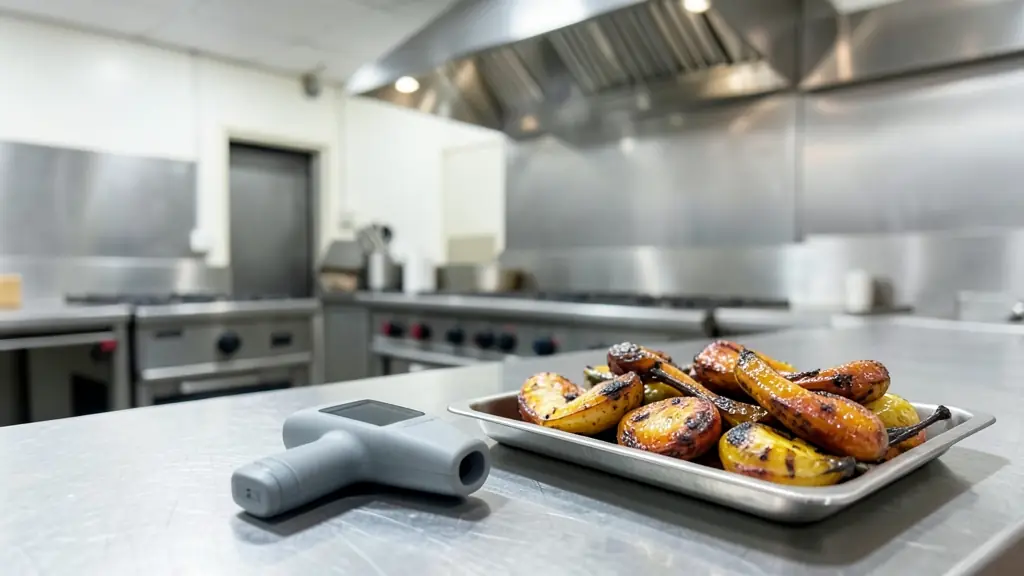
An infrared thermometer reads the heat a surface gives off and turns it into a temperature in about a second, with no contact. Kitchens use them on grills and fridge shelves, electricians on cable lugs, mechanics on radiators and bearings, and plants on ovens and kilns. They are quick and safe on things that are moving, live or too hot to touch, but they have limits that catch people out. This page explains how they work, the kinds there are, how to choose one and how to keep it honest. Send one request and suppliers near you quote you directly.
How it measures, and what it cannot do
The lens collects infrared energy from a round spot. Two numbers matter most. The distance to spot ratio (D:S) tells you how big that spot is: at 12:1 it is about 1 cm across from 12 cm away and about 10 cm across from 1.2 m. Keep the spot well inside the target, many makers suggest half its size, or you are measuring the background too. Emissivity is how well a surface gives off infrared. Most matt, painted and food surfaces sit near 0.95, the usual fixed setting, but shiny stainless steel, aluminium and copper read far too low. It measures the surface only, never the inside of a chicken or a pipe, and it cannot see through glass, clear plastic or water. Steam, smoke, dust and a dirty lens all upset it.
The main kinds
- Temperature guns: the everyday pistol grip for kitchens, HVAC and workshops.
- Pyrometers: high heat for furnaces, molten metal and kilns.
- Forehead thermometers: clinical models made for people, not surfaces.
- Thermal imaging cameras: a whole picture of heat instead of one spot.
- Fixed infrared sensors: mounted on a line and wired to a controller.
For core food temperatures you still need a probe, see food thermometers.
How to choose one
Start with the hottest and coldest thing you will measure: common general models cover about -50 to 400 or 550 °C, industrial ones reach 1,000 °C or more. Then think about distance. If you measure small targets from far away, such as a lug at the back of a board or a pipe across a plant room, pay for a higher D:S such as 20:1 or 30:1. Adjustable emissivity is worth having if you work on metals, and a Type K probe input lets one instrument do contact readings as well. Data hold, min and max, alarms and logging help with records. Accuracy is quoted on the maker's data sheet, often as a plus or minus figure or a percentage of the reading, so compare those sheets rather than the box.
Keeping it honest
Keep the lens clean and the batteries fresh, and let the thermometer settle when you carry it from a cold room into a hot kitchen, as it reads wrong until it catches up (see the manual). Check it now and then against a known surface or a contact probe. Where an auditor or customer wants proof, a calibration lab checks infrared thermometers against a blackbody source and issues a certificate; see thermometer calibration.
What to put in your request
- What you will measure and how hot or cold it gets
- How far away you stand and how big the target is
- Whether the surfaces are shiny metal
- Extras: Type K input, logging, alarms
- How many you need and whether you need certificates
Infrared Thermometers for industry, food, health, labs and homes
- Factories, mines and plants: bearings, motors, ovens, kilns and pipework checked on rounds without stopping the line
- Kitchens, butcheries and food factories: grills, fryers, hot holding counters and fridge shelves checked in seconds between orders
- Hospitals, clinics and pharmacies: surface checks on sterilisers, food trolleys and cold rooms, with clinical models used for patients
- Electricians, HVAC and refrigeration technicians: duct outlets, condensers, cable lugs, radiators and brake discs checked on every call-out
- Labs, schools and universities: hot plates, incubators and samples checked without opening a lid or touching a surface
- Cold stores and distributors: pallet and carton surfaces checked at the receiving dock before stock is accepted
- Farms, poultry houses and packhouses: milk lines, incubators, brooder heaters and motors on pumps checked quickly
- Households and families: pizza ovens, braai grids, geyser pipes and pool water surfaces checked at home
- Property managers, inspectors and security: geyser pipes, warm spots on walls and overheating plugs found on inspection rounds
Frequently asked questions
Do you sell infrared thermometers yourselves?
No. We are a free quote request service. Your request goes to independent suppliers who work in your area, and they quote you directly on price, stock and delivery. We do not make, sell or calibrate instruments ourselves. More on how it works.
Why does my thermometer read low on a stainless steel pot?
Shiny metal has a low emissivity and reflects the room around it, so a gun set at 0.95 reads well below the true temperature. Lower the emissivity setting if your model allows it, stick a patch of matt black tape on the surface and read the tape, or use a contact probe.
What does the laser do?
It only shows where you are aiming. The measurement comes from the round spot the lens sees, which grows with distance, and on many guns the laser dot sits off to one side of that spot. A strong laser is not a sign of a better thermometer.
Can I use an industrial infrared thermometer on people?
It is not made for that. Surface guns read the skin with a fixed emissivity and no correction to body temperature. For people, buy a clinical non-contact thermometer, and ask the supplier whether it is listed with SAHPRA. A reading is never a diagnosis.
Infrared Thermometers by province and city
- Johannesburg
- Pretoria
- Centurion
- Midrand
- Sandton
- Randburg
- Roodepoort
- Krugersdorp
- Randfontein
- Germiston
- Boksburg
- Benoni
- Kempton Park
- Alberton
- Vanderbijlpark
- Vereeniging
- Durban
- Pinetown
- Pietermaritzburg
- Richards Bay
- Newcastle
- Ladysmith
- Gqeberha (Port Elizabeth)
- East London
- Kariega (Uitenhage)
- Mthatha
- Cape Town
- Bellville
- Paarl
- Stellenbosch
- George
- Worcester
- eMalahleni (Witbank)
- Middelburg
- Secunda
- Mbombela (Nelspruit)
- Rustenburg
- Brits
- Klerksdorp
- Potchefstroom
- Mahikeng
- Polokwane
- Tzaneen
- Kimberley
- Upington
- Bloemfontein
- Welkom
- Sasolburg