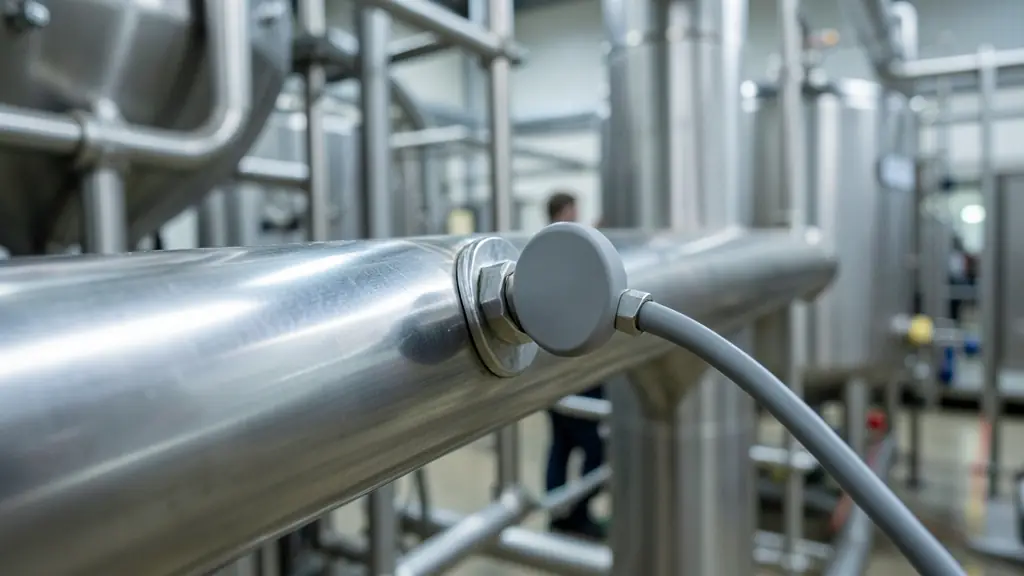
A temperature probe is a sensor in a protective sheath that sits in a pipe, tank, duct, oven or room and sends a reading to a controller, meter or logger. The most common accurate type is the PT100, a platinum resistance thermometer, with PT1000 and thermistors also widely used. Plants, boilers, HVAC systems, food factories and labs rely on them. This page explains the sensor types, accuracy classes, wiring, transmitters and thermowells and what to tell a supplier. Send one request and suppliers who make or stock probes quote you directly.
PT100, PT1000 and thermistors
A PT100 is a platinum element of 100 ohm at 0 °C, and its resistance rises in a known way as it warms. A PT1000 is 1,000 ohm at 0 °C, which makes long leads matter less and suits battery instruments. Platinum probes are more stable and accurate than thermocouples, over a narrower range: many go to about 600 °C. NTC thermistors are cheap and sensitive over a small range, and are found in fridges, geysers, HVAC and appliances, where the controller is made for a specific thermistor value.
Accuracy classes and wiring
Platinum elements are made to tolerance classes under IEC 60751, with Class A tighter than Class B, and some suppliers offer tighter still. The wiring matters too: a 2 wire probe adds the resistance of its leads to the reading, while 3 wire and 4 wire connections cancel it, which is why 3 wire is common in plants and 4 wire in labs. Check what the instrument or PLC input expects before you order. Also give the cable type and length: silicone or PTFE leads suit heat and wash-down, PVC suits dry, cool places, and screened cable helps near motors and drives.
Heads, transmitters and thermowells
Industrial probes often end in a connection head that can hold a 4 to 20 mA transmitter, so the signal travels far to a PLC without losing accuracy. A thermowell is a closed tube welded or screwed into a pipe or tank so the probe can be removed without draining the line and is protected from pressure and flow. Give the supplier the insertion length, the process connection (thread or flange), the sheath material and what flows past it. Fixed infrared sensors are an option where nothing can touch; see fixed infrared sensors.
Handheld, HVAC and multimeter probes
Not every probe is wired in. Handheld instruments take plug-in immersion, air, surface and needle probes, HVAC technicians use clamp-on pipe and duct probes, and many multimeters accept a Type K bead probe. Response time matters here: a thin needle reads in seconds, a heavy immersion probe in a thick sheath much slower, so wait for the reading to settle. Match the probe to the instrument, and for audit use have the probe and meter calibrated together.
What to put in your request
- The sensor: PT100, PT1000 or thermistor
- The class and the 2, 3 or 4 wire connection
- Sheath diameter, insertion length and connection
- Connection head, cable and any transmitter
- Whether you need a thermowell or certificate
Temperature Probes and PT100 Sensors for industry, food, health, labs and homes
- Factories, mines and plants: PT100 probes with transmitters in boilers, tanks, pipelines and process lines
- Kitchens, butcheries and food factories: hygienic probes on pasteurisers, cooking kettles and cold rooms in food plants
- Hospitals, clinics and pharmacies: probes in sterilisers, autoclaves and hospital HVAC systems
- Electricians, HVAC and refrigeration technicians: duct, pipe and room probes for HVAC and refrigeration technicians
- Labs, schools and universities: 4 wire PT100 reference probes for water baths, incubators and calibration
- Cold stores and distributors: cold room and freezer probes wired to controllers and loggers
- Farms, poultry houses and packhouses: probes in milk tanks, incubators, grain silos and greenhouse controllers
- Households and families: thermistor probes for geysers, solar water heaters and pool heat pumps
- Property managers, inspectors and security: probes in building HVAC, chillers and central hot water systems
Frequently asked questions
Do you make or sell temperature probes yourselves?
Should I choose a PT100 or a thermocouple?
Can I replace a probe without draining the pipe?
What details do I need to order a replacement probe?
Temperature Probes and PT100 Sensors by province and city
- Johannesburg
- Pretoria
- Centurion
- Midrand
- Sandton
- Randburg
- Roodepoort
- Krugersdorp
- Randfontein
- Germiston
- Boksburg
- Benoni
- Kempton Park
- Alberton
- Vanderbijlpark
- Vereeniging
- Durban
- Pinetown
- Pietermaritzburg
- Richards Bay
- Newcastle
- Ladysmith
- Gqeberha (Port Elizabeth)
- East London
- Kariega (Uitenhage)
- Mthatha
- Cape Town
- Bellville
- Paarl
- Stellenbosch
- George
- Worcester
- eMalahleni (Witbank)
- Middelburg
- Secunda
- Mbombela (Nelspruit)
- Rustenburg
- Brits
- Klerksdorp
- Potchefstroom
- Mahikeng
- Polokwane
- Tzaneen
- Kimberley
- Upington
- Bloemfontein
- Welkom
- Sasolburg