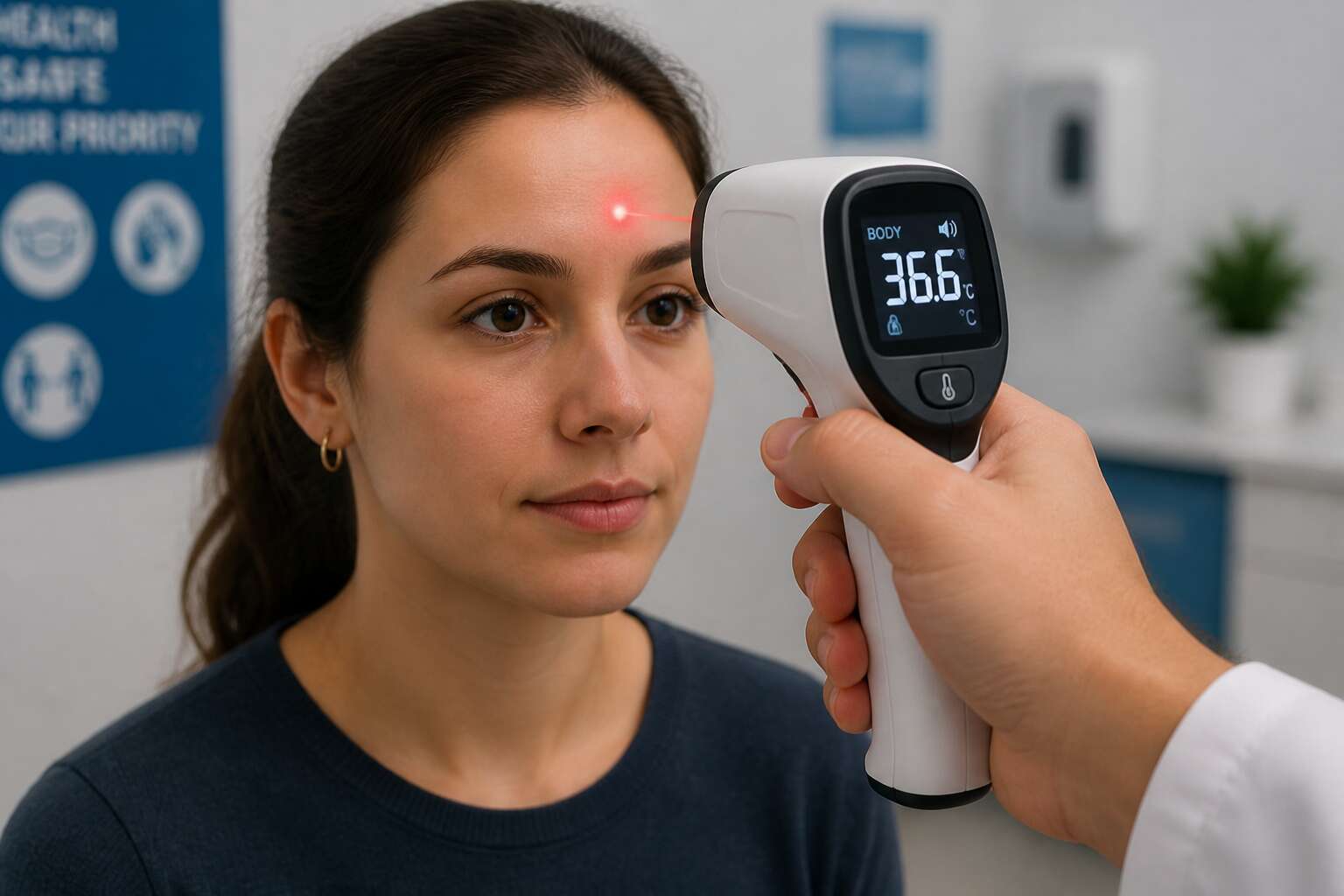
The Science Behind Non-Contact Temperature Sensing
How Infrared Radiation Translates into Readable Temperatures
Every object above absolute zero emits infrared radiation, a fact that makes non-contact temperature sensing possible. A thermometer laser gun reads this invisible energy and translates it into a precise temperature value. The device focuses infrared waves onto a detector, which converts the thermal signal into an electrical one. That signal is then processed and displayed as a readable number.
The laser serves a different purpose than many assume. It does not measure heat; it acts as an aiming guide. This distinction matters for accuracy. The infrared sensor captures radiation from the target area, while the laser simply shows where the measurement is taken. For industrial maintenance in South Africa, this allows technicians to assess equipment from a safe distance.
- Infrared radiation is emitted by all objects with heat
- The detector converts thermal energy into an electrical signal
- The laser sight ensures the sensor targets the correct surface
Understanding this process helps users trust the readings they obtain. The science is straightforward, yet the technology behind a thermometer laser gun remains remarkably refined.
Understanding the Role of the Laser Sighting Mechanism
A laser beam diverges at less than one milliradian, but that spread often decides between a reliable temperature reading and a misleading one. In practice, the thermometer laser gun uses this beam as a visual proxy for the infrared sensor’s field of view. The sensor and laser are aligned at the factory, yet parallax errors emerge at close range.
When measuring a rotor shaft or a transformer housing in South Africa, the offset between the laser dot and the actual sensing area becomes significant. In my experience, technicians must account for this.
- The laser guides the eye, not the measurement.
- Infrared detector reads a cone, not a point.
- Distance changes the target zone size.
Understanding the sighting mechanism prevents false confidence. A reading taken with the laser aimed at a hot joint while the sensor catches the cooler surface gives a composite value that is no use to anyone.
Emissivity and Its Impact on Measurement Accuracy
Somewhere in South Africa, a shiny heat exchanger is lying about its temperature. That is not opinion, that is emissivity. Emissivity is a material’s ability to emit infrared energy compared to a perfect black body. A polished aluminium surface might sit at a scorching 100°C, yet a thermometer laser gun will happily report 60°C because the metal reflects more than it radiates.
This is where the science gets uncomfortable. Industrial materials in Durban or Johannesburg are rarely pristine. Rust, oil, or a fresh coat of paint change the emissivity values faster than the afternoon thunderstorm. For example:
– Shiny metals sit around 0.05 to 0.2.
– Oxidized surfaces hover near 0.6 to 0.8.
– Most paints and coatings perform above 0.9.
If you set the gun to a generic 0.95, you are chasing phantom numbers. You must dial in the emissivity for the specific surface or, better yet, grab some flat black paint and mark the measurement spot. The sensor integrates the radiated heat from a cone, so mixed surfaces produce a weighted average. A transformer casing that is half-new paint and half-rust will give you a reading that satisfies nobody. Remember this rule: the thermometer laser gun is only as accurate as your emissivity setting allows it to be.
Distance-to-Spot Ratio: Why It Matters for Precision
The universe is a vast, cold place, and your thermometer laser gun is a tiny window into its thermal secrets. But beware, the instrument has a specific field of view, and it is not as simple as pointing and shooting. This is where the Distance to Spot ratio, or D:S, becomes the star of the show.
Imagine trying to measure the temperature of a single cable lug nestled within a crowded, humming switchboard. With a typical 12:1 ratio, standing a meter away means you are measuring a cone of energy from a spot roughly 8 centimeters wide. You are not getting the lug; you are getting the lug, the surrounding insulation, and a sliver of the metal cabinet. The reading is a thermal cocktail of everything in that cone. To get a true measurement, you must move closer or carefully account for the surrounding area. The laser dot only indicates the center of this zone, not its entire diameter.
For precision work, a thermometer laser gun with a higher ratio, like 30:1 or 50:1, earns its higher price tag. This higher ratio allows you to maintain a safe working distance from high-voltage equipment while still measuring a smaller, more defined target. Common ratios you will see are:
–
–
–
Think of the challenge in a sprawling plant in Secunda or a refinery in Sasolburg. A pipe running at 300°C is the target, but it is tucked behind other lines and safety barriers. A low-ratio device forces you into an awkward and potentially dangerous position. A higher D:S lets you stand back and still capture the accurate temperature of a relatively small component. Always ensure the target fills the spot size to get a trustworthy data point.
Critical Features to Evaluate in a Laser-Guided Thermometer
Temperature Range and Resolution Capabilities
A wide temperature range often separates a capable thermometer laser gun from a frustrating one. In South African industries, from foundries in Gauteng to cold storage facilities in the Cape, the span of measurable values dictates your tool’s versatility. A narrow range forces you to rely on secondary instruments, which defeats the purpose of remote measurement.
Resolution matters just as much as the range itself. The display’s incremental steps, whether 0.1°C or 1°C, influence how precisely you can track thermal drift. A coarse resolution hides subtle shifts that signal equipment failure before they become catastrophic.
When I evaluate a unit for industrial use, I check three benchmarks:
– The lowest readable temperature for refrigeration audits
– The upper threshold for kilns and furnaces
– The consistency of readings at both extremes
A budget thermometer laser gun might quote impressive numbers, but the real measure is stability across that entire span. Verify the sensor’s response time at the extremes, since sluggish updates distort your understanding of rapid changes.
Adjustable Emissivity Settings for Different Surfaces
Adjustable emissivity settings separate a professional thermometer laser gun from a budget model. In South African plants, you might measure polished stainless steel in a Durban fabrication shop one moment and matte rubber on a conveyor line the next. Each surface reflects infrared energy differently. A fixed emissivity of 0.95, common on cheaper units, will misread shiny metal by dozens of degrees. That error cascades into flawed quality checks and unsafe process decisions.
When I evaluate a unit for clients, I look for these capabilities:
- Preset values for common materials such as steel, aluminium, and food products
- Manual adjustment in 0.01 increments for custom or coated surfaces
- Memory that stores your last emissivity setting between sessions
A thermometer laser gun with adjustable emissivity lets you match the device to the material in front of you. Without this feature, readings become unreliable, and your process data loses its meaning.
Response Time and Sampling Rate Explained
Response time dictates whether you read the surface or the seconds after it changed. A slow thermometer laser gun captures the cooling trace, never the actual peak. On a fast conveyor in a Johannesburg bottling line, the target sits in view for a fraction of a second. You need a device that reaches 90% of the true value in under 300 milliseconds. Sampling rate follows the same logic. A thermometer laser gun refreshing twice per second blurs the variations between readings. You miss the spike entirely!
Check these specifications:
- Response time between 150 and 300 ms
- Sampling rate of at least 10 readings per second
- Digital display refresh that keeps pace with both
The combination reveals the moving parts of your process. It shows real peaks and troughs, not smoothed guesses. That is how you catch a failing bearing before it seizes or a weld seam before it cracks. Precise timing turns a simple reading into real protection.
Display Type, Backlight, and Data Hold Functions
The display is your primary interface with the measurement. A thermometer laser gun fitted with a high contrast LCD or OLED screen remains readable under the harsh Highveld sun, where cheaper units wash out completely. I have watched technicians squint at faint digits and misread values by several degrees. Backlighting earns its keep in dark boiler rooms or night shift inspections, turning a shadowed panel into a clear readout without requiring a torch.
- Pixel size and refresh cadence for rapid value changes
- Viewing angle stability when you hold the unit off center
- Auto dimming versus manual brightness for battery conservation
Data hold functions lock the final reading, which matters when the target vanishes behind moving conveyor parts. Without it, you chase a flickering number and lose your mental anchor. A robust hold feature stores that value until you register it, reducing strain during repetitive quality checks. Combined with a quick sampling rate, your thermometer laser gun becomes a dependable partner in demanding industrial conditions across South Africa.
Durability, IP Ratings, and Ergonomics for Field Use
Field use in South Africa presents a demanding environment for any handheld instrument. A thermometer laser gun living inside a bakkie cab endures constant solar gain, while one strapped to a harness collects coal dust and corrosive mine moisture. Instead of trusting the manufacturer’s bold claims, I check the ingress protection rating first. Specs like IP54 guard against light dust splatter, but continuous vibration from a nearby pump line will loosen a poorly designed housing. The lens mount and battery door are the first points of failure in practice.
Ergonomics are nuanced yet decisive on a hard shift. A contoured grip allows you to hold a steady reading position without clenching your fingers until they cramp. The trigger needs a defined tactile stop so you know exactly when the measurement initiates, no guessing through thick gloves. Balance rests near the battery compartment, counterbalancing the weight of the optic. I tap the unit against my palm and listen for dull rattles before purchasing anything. A robust body protects the internal laser board, ensuring your thermometer laser gun stays accurate through years of rough handling.
Battery Life and Auto-Shutoff Mechanisms
Battery chemistry dictates field endurance more than capacity figures suggest. A thermometer laser gun parked in a warm bakkie loses lithium cell charge faster than the spec sheet admits. I look for low quiescent current draw, the standby drain that quietly kills batteries between uses.
Auto shutoff timing matters:
- Thirty seconds is aggressive, ideal for quick spot checks.
- Two minutes suits long scanning sessions.
- A user adjustable setting is the rarest and best option.
Infrared sensors reconstruct the same scene twice each second. A trigger held against a vibrating pipe does not waste battery on idle logging. The smart circuit kills the laser diode promptly when the trigger releases. A thermometer laser gun with a removable battery beats a sealed pack. Swapping cells costs seconds, not shift downtime.
Practical Applications Across Professional and Home Settings
HVAC Diagnostics for Ventilation and Insulation Testing
In Johannesburg’s older suburbs, a thermometer laser gun turns a routine ceiling inspection into a forensic exercise. Point it at a vent outlet and you will see immediately whether the air conditioning is performing or merely pretending. Professionals use these readings to trace blocked ductwork, while homeowners finally learn why the guest bedroom never reaches a livable temperature.
For insulation testing, the same device exposes thermal bridges where heat escapes through cavity walls. A rapid temperature drop across a plasterboard surface signals gaps in the fibreglass behind it. Ventilation audits benefit equally. Measure the supply grille, then the return air duct. A difference of more than three degrees reveals the system is recirculating stale air, the quiet culprit behind persistent condensation and musty odours.
Automotive Troubleshooting for Engines and Brake Systems
The engine bay contains a variety of heat signatures. A thermometer laser gun reveals where combustion energy turns into waste. In Johannesburg’s traffic, an overheating cylinder head often hides behind a normal gauge. Scanning the exhaust manifold and radiator hoses exposes a failing thermostat before it strands you on the M1.
Brake systems demand the same scrutiny. After a hard descent down Suikerbosrand, point the thermometer laser gun at each rotor. A temperature difference of more than forty degrees between left and right suggests a seized caliper or a collapsed brake hose. That reading explains why the car pulls to one side.
For DIY home mechanics, this tool simplifies diagnostics:
- Check wheel hubs for uneven bearing wear.
- Verify intercooler efficiency via intake air temperature.
Professionals in panel shops use the same method to confirm paint ovens cure evenly.
Culinary Safety: Checking Oil Temperature and Grilling Surfaces
In a bustling Johannesburg kitchen, a thermometer laser gun gives you the actual oil temperature without dipping a probe into hot fat. The oil in the deep fryer needs to reach 180°C before the batter goes in. You stand back, aim, and pull the trigger. The reading shows instantly. This avoids the risk of burns and keeps the cooking oil uncontaminated.
The same approach applies to grilling surfaces. Cast iron griddles develop hot spots that the naked eye cannot detect. Point the thermometer laser gun across the plate and you see temperature variance of up to forty degrees between zones. That explains why one side of the steak burns while the other stays pale. You move the meat to the area that matches your target heat.
Electrical Maintenance: Identifying Overheated Components
An electrical panel holds secrets that only reveal themselves through heat. A thermometer laser gun lets you scan breaker terminals and bus bars without touching live components. This matters because resistance creates warmth before failure occurs.
In a Johannesburg suburb, a homeowner noticed a faint burning smell near the distribution board. The thermometer laser gun showed one breaker running at 78°C while its neighbours sat at 40°C. That difference pointed to a loose termination. Tightening it prevented a potential fire.
For electricians, routine scans of:
– Overloaded circuits
– Corroded connections
– Failing contactors
This approach helps identify problems before they escalate. The same practice works for DIY enthusiasts checking appliances or wall sockets, though caution is essential around live electricity. I always advise keeping the laser off and relying on the infrared sensor when working near reflective surfaces.
Home and DIY Projects for Appliance and Fixture Checks
Checking appliances with a thermometer laser gun is faster than guessing. A fridge compressor that feels warm to the touch might run at 55°C normally. When it hits 70°C, the condenser coils need cleaning. I use mine on light fittings too. A downlight that runs hotter than its neighbours can signal a failing transformer or poor insulation. For a quick home audit, work through these spots:
– Oven door seals
– Geyser thermostat settings
– Distribution board terminations
The trick is to remember that surface temperature tells you what is happening inside. In a Pretoria home, a wall socket that read 48°C revealed a loose wire behind the plaster. The owner switched off the circuit before calling an electrician. That thermometer laser gun saved a wall, and possibly more.
Best Practices for Accurate Readings and Longevity
Proper Aiming Techniques and Avoiding Reflective Surfaces
Accurate readings from a thermometer laser gun depend on how you position the device. The laser is a sighting aid, not a measuring tool. It reveals where you are aiming, but the infrared sensor captures energy from a broader area. Hold the unit steady and perpendicular to the target. Move closer when possible to shrink the spot size economy.
Reflective surfaces create a serious problem. Polished metal, glass, and glossy paint scatter infrared radiation, sending false signals back to the sensor. You might point at a hot pipe and get a reading for the colder wall behind it. Apply a flat coating, such as masking tape or matte paint, before measuring. Then aim the thermometer laser gun at that covered spot and wait for a stable number.
- Clean the lens after each use.
- Protect the device from direct sunlight.
Calibration Checks and Verification Against a Reference Standard
Calibration keeps a thermometer laser gun honest. I check mine against an ice bath and a boiling point reference every few weeks. The ice bath should read 0 degrees Celsius, within a half degree. Boiling water at sea level should show 100 degrees Celsius, but here in Johannesburg, the altitude lowers that number, so I use a certified reference standard instead.
- Store the device in a padded case
- Replace the battery at the first sign of low voltage
- Log the verification results after every 50 uses
Longevity depends on these small habits. A thermometer laser gun that drifts silently can mislead you for months. Compare readings against a contact probe on a warm surface. The two should agree within a degree or two. If they do not, professional recalibration is necessary.
Cleaning the Lens and Handling Extreme Environmental Conditions
Dust and grime are silent enemies. A smudged lens scatters infrared energy, which means the thermometer laser gun reports a temperature that never existed. I clean mine with a blower brush before each shift, followed by a microfibre cloth. Fingerprints leave oils that bake onto the optics, so I never touch the glass directly.
Extreme environments demand respect. Moving from an air conditioned vehicle into the Highveld sun causes condensation inside the housing. That moisture distorts the sensor. Give the thermometer laser gun time to equalise with the ambient temperature, and keep it out of direct sunlight.
- Use a blower before wiping the lens
- Store the unit with the lens cap secured
- Allow ten minutes for the device to acclimatise
These small routines keep readings consistent across changing seasons.
Understanding Limitations with Transparent Materials and Steam
A thermometer laser gun can lie to you when the target is transparent or steaming. Glass and clear plastics allow infrared to pass through, so the sensor reads the background. Steam scatters the signal, turning a reading into a blend of temperatures. I once aimed at a boiling kettle and got 22 degrees.
Longevity begins with understanding these limits. For glass, attach a patch of matte tape to create a solid reference. For steam, measure the container wall before vapour forms. Keep the unit at the correct distance from the target. Store it with the lens cap on and let it equalise after moving between hot and cold zones. These steps keep readings accurate for years.
Storage, Battery Care, and Routine Maintenance Schedules
Every thermometer laser gun degrades slowly. The question is whether you notice before it matters. I have seen too many good units fail from neglect. Log each reading session with the ambient temperature and humidity. Patterns emerge: a unit that drifts in winter, a battery that dies after repeated cold exposure. These records transform guesswork into predictability.
Storage determines how long the thermometer laser gun stays honest. Remove batteries if the device will sit for more than a month. Coastal humidity corrodes contacts without visible warning. Keep the unit in a sealed case with a desiccant pouch, away from window light.
Battery care follows a simple rhythm:
- Check terminals for corrosion after every battery swap.
- Record the installation date on the device’s label.
- Replace cells on the first day of each quarter, not when warnings appear.
A routine schedule keeps failure predictable. Occasional use without structure lets calibration and battery life degrade unnoticed.
Comparing Laser-Guided Units to Contact and Traditional Tools
Advantages Over Probe and Mercury-Based Thermometers
Some tools demand patience, a steady hand, and the willingness to get uncomfortably close to a hot surface. The thermometer laser gun destroys that entire ritual. While a probe thermometer requires physical contact, which risks cross-contamination and forces you to wait for the sensor to stabilize, the laser-guided unit reads from a safe distance. You simply pull the trigger and receive an instant surface temperature reading. This difference is not a minor convenience; it represents a fundamental shift in how you approach the job.
Consider the process of checking a frying pan. With a traditional probe, you must touch the metal, wait for the needle to climb, and hope the contact point is accurate. Mercury-based thermometers are worse, presenting a fragile glass hazard and a slow response time. The laser method eliminates the wait and the danger. It reads the infrared energy radiating from the target in a split second.
The advantages of this approach are practical and immediate:
– No contact means no cleanup or risk of breaking a glass tube.
– Instantaneous feedback allows for rapid adjustments without lag.
– Safe operation keeps your hand away from hot oil, moving machinery, or live electrical parts.
This precision also addresses the issue of contamination. In food preparation, inserting a probe into meat creates a pathway for bacteria. A laser unit observes the surface without breaching it, keeping the sample clean and the process efficient. For industrial electricians, the benefit is even more stark. Touching a suspect breaker with a probe exposes you to arc flash risks. The laser gun lets you scan a panel from a safe distance, identifying the anomaly without the hazard. The old mercury devices are practically obsolete in these scenarios, while the laser tool delivers speed and safety in a single, focused beam.
Speed and Safety Benefits in Hazardous or Moving Targets
A thermometer laser gun measures a spinning shaft or vibrating pipe in under a second, while a probe struggles to maintain contact. This speed advantage transforms how you approach any moving target. You no longer need to stop equipment or risk a hand getting caught between components to get a reading.
The safety benefits are equally stark. For hazardous targets like high-voltage switchgear or rotating machinery, distance is your primary protection. A contact tool forces you into the danger zone. The laser unit keeps you at a safe remove.
– No physical contact means no entanglement hazard.
– Instant readings reduce exposure time.
– Non-invasive scanning prevents disturbance to the target.
Probe thermometers demand physical proximity and stable contact. In an industrial setting, that is a liability. The thermometer laser gun turns a dangerous task into a routine observation.
Cost-Benefit Analysis Versus High-End Thermal Cameras
In South African industry, the cheapest thermometer is often the most expensive one. A contact probe costs a few hundred rand, but every reading demands shutdown, access, and paperwork. A thermometer laser gun removes those steps, and its purchase price becomes negligible against the labour it saves.
High-end thermal cameras are another option entirely. They deliver detailed images, yet require software, training, and calibration cycles that can double the initial investment. For a single surface temperature, that is excessive. I would not buy a camera to read one bearing. The thermometer laser gun produces the same reading for a fraction of the outlay.
Compare the cost structure:
- Contact tools: low purchase price, high labour cost per reading.
- Laser unit: moderate price, near zero operating cost.
- Thermal cameras: high price, high skill requirement, expensive upkeep.
Situations Where Sensor-Based or Wired Probes Are Superior
A thermometer laser gun reads surfaces, not interiors. For a bearing housing that works. But for a vat of wort or a fermentation tank, you need the liquid itself. That is where a sensor-based probe earns its keep.
Wired probes shine when the target is obscured, moving, or coated with a reflective film. They also provide continuous data logging, something a trigger pull cannot match.
- Buried or encapsulated components where no line of sight exists.
- Low-emissivity metals like polished aluminium that confuse infrared sensors.
- Processes requiring a permanent, recorded temperature history.
For those tasks, a simple thermocouple or RTD delivers accuracy without guesswork.
Selecting the Right Tool Based on Your Specific Industry Needs
Choosing between a thermometer laser gun and a contact tool comes down to the specific job. In South African industries, from citrus packhouses to metal fabrication shops, access, surface condition, and safety drive the decision.
I have watched teams waste hours shutting down a conveyor for a single bearing reading. A thermometer laser gun reads that surface from a safe distance in seconds. That speed matters in high-volume plants.
Contact tools still hold their place. They provide internal readings for liquids, gases, and embedded components. The difference shows up in three practical questions:
– Is the target moving or remote?
– Does the surface reflect or emit poorly?
– Do you need a permanent record?
Most routine surface checks favour the laser-guided unit. Process validation demands wired probes.


0 Comments